
Legal
Carbon Reduction Plan
Reporting Year: 1st January – 31st December 2024
Published: February 2025
We are all stewards of this planet. From the technology we supply to our customers to our delivery network, we have the opportunity and responsibility to identify, practice and promote meaningful solutions to the global challenges we all face.
Our fourth annual Carbon Reduction Plan (CRP) documents our progress towards net carbon neutrality by 2050 in accordance with Procurement Policy Note PPN06/21 (“Taking Account of Carbon Reduction Plans in the procurement of major government contracts”).
As a company, we have taken things a step further by committing to reduce our own carbon emissions to a level of carbon neutrality by 2030, with net zero emissions secured by 2040.
Introduction
This report was published on 12th February 2025, to be reviewed in January 2026 and updated the following February. Our progress towards achieving Net Zero is reviewed by the Environmental Working Group (EWG) and sponsored by Getech’s executive team.
Throughout this CRP, you’ll see the phrase “carbon emissions” used quite frequently; this phrase refers to all greenhouse gas (GHG) emissions (CO2 equivalent/CO2e).
Our Purpose
Our purpose is to sustainably deliver exceptional standards of hardware and software solutions and value-added services to a broad range of vertical markets throughout the UK and beyond. As a business, we continue to place sustainability and positive transformation of our supply chains at the forefront of the work we do, so that we can deliver long-term and legitimate quality for our customers and their communities, while establishing a legacy of best practice, backed by consistently distinguished and demonstrable results.
Commitment to Achieving Net Zero
We fully support the Sustainable Development Goals (SDGs) outlined by the United Nations (UN) and the Paris Agreement 2015 to reduce GHG emissions and promote global security. We regularly review all of our policies and practices to ensure that environmental and sustainability considerations remain at the core of our continuous improvement, striving to reduce emissions, eliminate waste and balance our consumption of electricity, water and fuel throughout our operations.
Getech’s ‘operational’ emissions (those emissions in Scopes 1 and 2) relate to our use of energy for maintaining operations; as such, we can directly influence and control them. Our ‘value chain’ emissions (Scope 3) include those created by our business indirectly, such as via our waste management partners.
We have made considerable progress to accurately map and record our emissions, yet we remain focused on identifying opportunities to improve our reporting and to better support our customers on their own journeys towards a net zero carbon economy.
Baseline Emissions Reporting
Baseline Year: 1st January – 31st December 2019
We have selected 2019 for the baseline year due to the closer correlation of data to a forecasted standard operational year. Where Scope 3 data has not been recorded previously, every effort has been made to procure accurate estimates based on consistently applied calculations and all available facts.
At present, Scope 3 reporting excludes figures regarding Getech’s ‘Upstream’ and ‘Downstream’ transport and distribution-related emissions, as well as data regarding our employee commuting. Scope 1 emissions have been calculated based on an extensive review of our gas consumption and vehicle mileage for the calendar year, with Scope 2 emissions determined via the same methods regarding our electricity consumption.
For both Scopes 1 and 2, we have reviewed all available consumption data and cross-referenced these figures with relevant invoices to ensure data accuracy. Scope 2 figures have been reported using both market-based and location-based calculations, with location-based calculations included in our annual totals. Market calculations have been ‘zeroed’ due to Getech’s energy supply being sourced from 100% sustainable REGO-backed fuel mixes, which complies with the current definition for ‘zero carbon.’
| Emissions | Baseline Year (2019) | Reporting Year (2024) |
|---|---|---|
| Scope 1 | 18.33 | 1.8 |
| Scope 2 (Market-based) | 0.00 | 0.00 (Renewable energy generation) |
| Scope 2 (Location-based) | 79.33 | 38.70 |
| Scope 3 | 4,053.2 | 596.36 |
| Scope 3: Business Travel | 18.94 | 15.34 |
| Scope 3: Waste | 3,752.16 | 114.40 |
| Scope 3: Upstream Transport | 151.89 | 117.04 |
| Scope 3: Downstream Transport | 25.19 | 304.44 |
| Scope 3: Transmission & Distribution | 6.74 | 3.42 |
| Scope 3: Employee Commuting | 98.30 (Estimated) | 41.70 (Surveyed and upscaled) |
| Total Emissions | 4,150.86 | 637.00 |
Summary
- Scope 1 emissions were 1.8 tCO2e which equates to 9.81% of the 2019 baseline emissions.
- Scope 2 emissions were 38.70 tCO2e which equates to 48.78% of the 2019 baseline emissions.
- Scope 3 emissions were 596.36 tCO2e which equates to 14.7% of the 2019 baseline emissions.
Emissions Reduction Targets
With the goal of supporting our progress towards net zero emissions, we will be reviewing our carbon targets throughout 2024 to align with and reflect the exceptional progress which has been made since our original baseline in 2019.
Where we have been able to procure several years of consistently detailed and comprehensive data, we will then implement revised targets for carbon reduction in future years.
Total Carbon Generation
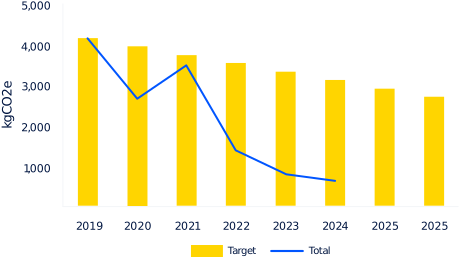
Getech is significantly ahead of our schedule to deliver carbon savings across the company and reduce the carbon emissions attributable to our business operations.
Using a gradual reduction target of approximately 5% per year, we initially set a Net Zero target of 2040. On this basis, our original aim was to reduce emissions to 3,039 tCO2e by 2024; a reduction of ~25% when compared to baseline emissions of 3,868 tCO2e in 2019.
However, due to high impact activities early in the project including waste management optimisation, energy efficiencies and the use of renewables, in 2024 Getech had actually achieved an overall reduction of 85.1% compared to the 2019 baseline year. This takes our total carbon generation down to 15.3% of our original baseline and well ahead of our target of 73.2% for this period.
It is acknowledged that with the large-scale impacts delivered by these initial projects, future improvements may not be on the same scale and carbon reduction is expected to be more gradual. Getech’s Environmental Working Group (EWG) regularly assesses performance against these targets and will work to achieve greater reductions where they may be realistically achieved.
In 2025, Getech’s EWG will be working to plan the next few years of projects and their impact upon the emissions of the company. This will then influence any revisions to the Carbon Reduction Plan and potentially bringing the targeted Net Zero date forward.
Carbon Reduction Projects
In completing the analysis required to publish this report, Getech’s Sustainability Manager and EWG team have identified further improvements to the reporting process that has resulted in more accurate and consistent data for the Carbon Reduction Plan and Net Zero reporting.
As a result of these reporting techniques being put in place in the preceding years, we have reviewed our historic submissions and where possible have applied these new techniques to provide comparable and transparent reporting as we continue our journey towards Net Zero.
The projects which Getech have enacted since producing its baseline for emissions in 2019 have yielded a total reduction of 3514 tCO2e to date; averaging a reduction of 702.8 tCO2e per annum and reducing our emissions to 14.9% of the 2019 baseline.
All data collection, reporting functions and project actions are overseen by Getech’s EWG, who are responsible for reporting this information directly to the board of directors for their consideration. These projects are further informed by the discussions and decisions made by our staff as the business finalises its transition into Employee-Owned Trust (EOT) status.
We recognise that truly meaningful reductions and promoting sustainability can only be achieved through ongoing engagement and collaboration with every single one of our colleagues, as well as those suppliers and customers with whom we conduct business. As a business, we promote a ‘sustainability first’ ethos in our operational and strategic planning, working closely with our community to ensure that we’re living up to the full expectations of our environmental responsibilities.
Finally, we continue to improve our monitoring and recording methods to produce relevant and insightful analysis, along with assessment of trends and contributing factors which may influence our projects and their efficacy. To this end, we are working closely with our supply chain to more effectively map the emissions generated within it, with a view to providing more effective reporting to our customers and enabling them to make evidence-based decisions which are appropriate for their organisations.
Certification to BS EN ISO 14001:2015
We continue working towards formalising our Environmental Management System (EMS) for certification to the BS EN ISO 14001:2015 standard. This work includes substantial review and revision of corporate policies and standards, along with supporting guidance and processes to identify and reduce the environmental impacts and material resource costs of all operations.
Getech is currently maintaining and improving a robust EMS, including policies, standards, guidance and processes to identify and reduce the environmental impacts of all operations. As a result of our increased focus on sustainability throughout the business, we have made the strategic decision to advance plans for ISO 14001 certification, with the view to achieve certification by the end of calendar year 2025.
Electricity Management Measures
To date, Getech has reduced its energy consumption by 35.8% when compared to initial 2019 baseline figures. This equates to an average reduction of 22,270.8 kWh per annum; or a total reduction of 111,354 kWh since baseline year.
We continue to manage our electricity supply closely, ensuring that all energy consumed by the business is generated from renewable and sustainable sources. In 2024, we changed electricity supplier and our commitment to 100% sustainable energy generation was our key consideration when changing suppliers.
All projects and activities are carefully coordinated to ensure that energy efficiency remains a key concern, with lowest energy and carbon cost options given precedence over less sustainable alternatives. We also remain dedicated to operating effective power management policies on all company devices, ensuring that hardware is provisioned appropriately for the purposes it is required; this means that devices are powered down when not in use, of a suitable specification to meet requirements, configured to prioritise energy efficiency, and used in a manner which is consistent with industry best practices.
All activities are planned with a view to reusing existing devices to prevent overprovisioning wherever possible, and any devices in use must have an efficient and effective consumption of power, with those which are drawing additional power needlessly or are over-specified for the project being replaced with an appropriate alternative. The long-term goals of these activities are to reduce the overall energy consumption of the business, to reduce operational costs and to promote an energy efficiency ethos which is supported by all members of our team.
Getech has significantly invested in EV charging infrastructure over several years with 4 chargers installed in 2021 and further 11 installed in 2024. This is encouraging an increasing number of staff to transition to sustainably powered vehicles for personal and commuting use, as well as providing a base for EVs to be prioritised as business vehicle replacements, expected at next vehicle renewal in 2026 and over the following few years.
In 2024, a total of 12,113 kWh electricity was provided to EV charging which is an increase of 33% on 2023.
Heating/Cooling Management Measures
Following our previous transition to the use of energy-efficient IR lamp systems to heat large-volume spaces, We have now eliminated use of gas fossil fuels entirely. As of 2022 Getech has been a gas-free business; in addition to this, we are pleased to report that as of February 2023, our gas meter has now also been physically disconnected and removed from site.
We also continue to enforce a ‘closed door’ policy to ensure that premises are effectively secured, to improve the energy efficiency of various spaces throughout the building and to enable us to further assess the external surface insulation of premises and the levels of heating or cooling required for ideal operations.
Further to our migration of business operations to a cloud-based environment, we have now successfully decommissioned our on-premises datacentres. This has drastically reduced the levels of cooling required to maintain hardware stability and has enabled us to repurpose the space as a Switching room for our remaining infrastructure.
Throughout 2025, we will be conducting a review of its infrastructure and assets to ensure that heating and cooling management methods are efficient and environmentally sustainable. This will commence with a review of our air conditioning units and their associated emissions.
Print Reduction Measures
As our systems and processes continue to be further digitised, the removal and scaling back of print devices throughout the premises remains ongoing. Further assessment of our printing requirements has also identified areas in which printing cannot be eliminated (from an operational perspective), and as such we have begun to research alternative technologies which we might employ to address these obstacles. The business continue to operate a printer queue management system, with two multi-functional print devices provided to facilitate business activities.
Getech continues to assess the viability of implementing a ‘follow me’ printing solution within the premises, which will seek to further reduce waste, printing costs and associated carbon emissions by only releasing print jobs to the device when the staff member is physically stood at the printer.
Upsteam & Downstream Transport Measures
As a result of our concerted efforts to engage with our supply chain and improve the quality and accuracy of data being shared and reported, Getech is now equipped to provide more comprehensive data and more meaningful insights into our carbon costs and emissions associated with the downstream and upstream distribution/transport of our goods and services.
In efforts to enhance our reporting, we have engaged our supply chain partners to begin providing more comprehensive data and insights into carbon costs and emissions associated with upstream and downstream distribution and transportation. With a view to providing more transparent informational reporting to our customers and their end users, we continue to emphasise the importance of accurate and thorough record-keeping.
As part of the drive towards fostering a more sustainable supply chain, Getech has committed to comprehensive audits of our Tier 1 supply partners, along with those subcontractors we engage routinely in providing goods and services to customers.
Business Transport Measures
We have continued to see substantial growth in 2024, as our teams work diligently to support colleges, schools, universities and businesses across the UK. Getech will continue to review its business travel policies, aiming to identify the most efficient and sustainable means of effectively reducing the carbon emissions generated by such activities.
We continue to ensure that each project and/or activity we undertake as a business gives prioritisation to lowest carbon costs for transport and logistics. We encourage all of our colleagues to engage with sustainable and low carbon cost means of transport, and we continue to invest in our own low-carbon infrastructure to support non-carbon emitting vehicles across our premises; as a result, we’ve seen a substantial increase in the numbers of fully electric and hybrid vehicles being used by our staff.
All projects, deployments, deliveries and installations are coordinated to ensure that low carbon emitting vehicles and modes of transport remain prioritised, and to ensure that routes are effectively planned and monitored to ensure maximum carbon efficiency. Where our colleagues may be travelling nationally, or even internationally, we always encourage them to use low carbon emitting means of travel, such as public transport options where they are readily available.
Getech’s own infrastructure, which includes a number of charging bays for electric vehicles (EVs) and hybrid vehicles, continues to be developed and expanded to address the changing landscape of sustainable business travel. We have also implemented a successful salary sacrifice scheme for the provision of electric vehicles and continue to take measures to review the current corporate fleet of vehicles in use. Our Fleet Manager reviews each vehicle in the corporate fleet at the point of renewal to determine whether the vehicle is still required, and whether any more sustainable alternative may be found to meet the requirements of the business.
We also actively engage with local councils and community members to encourage the use of public transport, promote the move away from high carbon-generative modes of transport, foster greater personal responsibility and awareness of environmental impact and to support walking and cycling in the area. Through various direct channels and business outreach/engagement programmes, we intend to continue to discuss and promote these topics wherever possible.
In encouraging colleagues to adopt low carbon emitting means of commuting, with a view to promoting an ethos of sustainably focused commuting throughout the business, Getech works to develop a robust and deepened understanding of its transportation requirements. By more effectively comprehending the transport needs of the business and our colleagues, we aim to increase the use of public transport, walking, car sharing and cycling as means of commuting to work regularly.
Carbon Offsetting
At Getech, we believe that the first and most effective means of achieving net zero emissions is the long-term elimination of carbon-generating activities and resources. With that said, it is increasingly common for businesses to engage in carbon offsetting to address their environmental impact.
As research in the field continues, we pay close attention to any developments in the prevailing wisdom regarding the reduction of carbon emissions. More than ever, it remains vital that we continue our commitment to implement practical and proactive measures which substantially reduce the need for offsetting, thus contributing to the net zero ambitions of the United Kingdom and alleviating the weight of responsibility on carbon offsetting to save the day.
Getech aims to address carbon reduction with a holistic approach, with the understanding that achieving true net zero emissions will involve a combination of methodologies and schools of thought; by extension of this, we view carbon offsetting as an alternative methodology at this time, though we have given consideration towards mapping and offsetting our historic emissions via Gold-standard projects which focus on rewilding and reforestation throughout our local and national communities.
We remain dedicated to our ultimate aim of achieving net zero carbon emissions by 2040; however, we are also investigating the opportunity to become carbon negative and environmentally positive before this goal, by sequestering carbon in excess of our levels of emissions and actively addressing carbon levels beyond those created by our business.
Project Management Measures
As an expansion of our ethos of “sustainability first,” Getech places carbon management and environmental awareness at the very heart of all internal and external projects. Engaging and insightful ongoing collaboration with our supply chain and our customers enables us to understand the needs of our customers and business more accurately, ensuring that we provide the most effective and appropriate solutions at the right times. As we continue to liaise with customers and suppliers, we aim to ultimately provide comprehensive and transparent carbon reporting to support effective evidence-based decision making.
We also promote the ethos of “Rethink, Reduce, Reuse & Recycle”, asking all colleagues to give deeper attention to the requirements of the project brief and to consider where their work can be aligned to achieve more sustainable and environmentally conscious results.
Measuring Success
Throughout 2024, we have continued to build upon the quality and scale of our data collection for monitoring and measuring success against our carbon reduction targets.
Effectively reporting on the success of our environmental measures is a key tool in our repertoire when promoting and expanding sustainability and environmentally sustainable business practices. We employ a wide range of methods to tackle our carbon emissions, but each remains consistent and measurable, providing us with intimate observations and performance data for analysis and assessment. We appreciate the significant value represented by a truly sustainable business model, especially one which actively promotes longevity and environmentally conscious proactive behaviours.